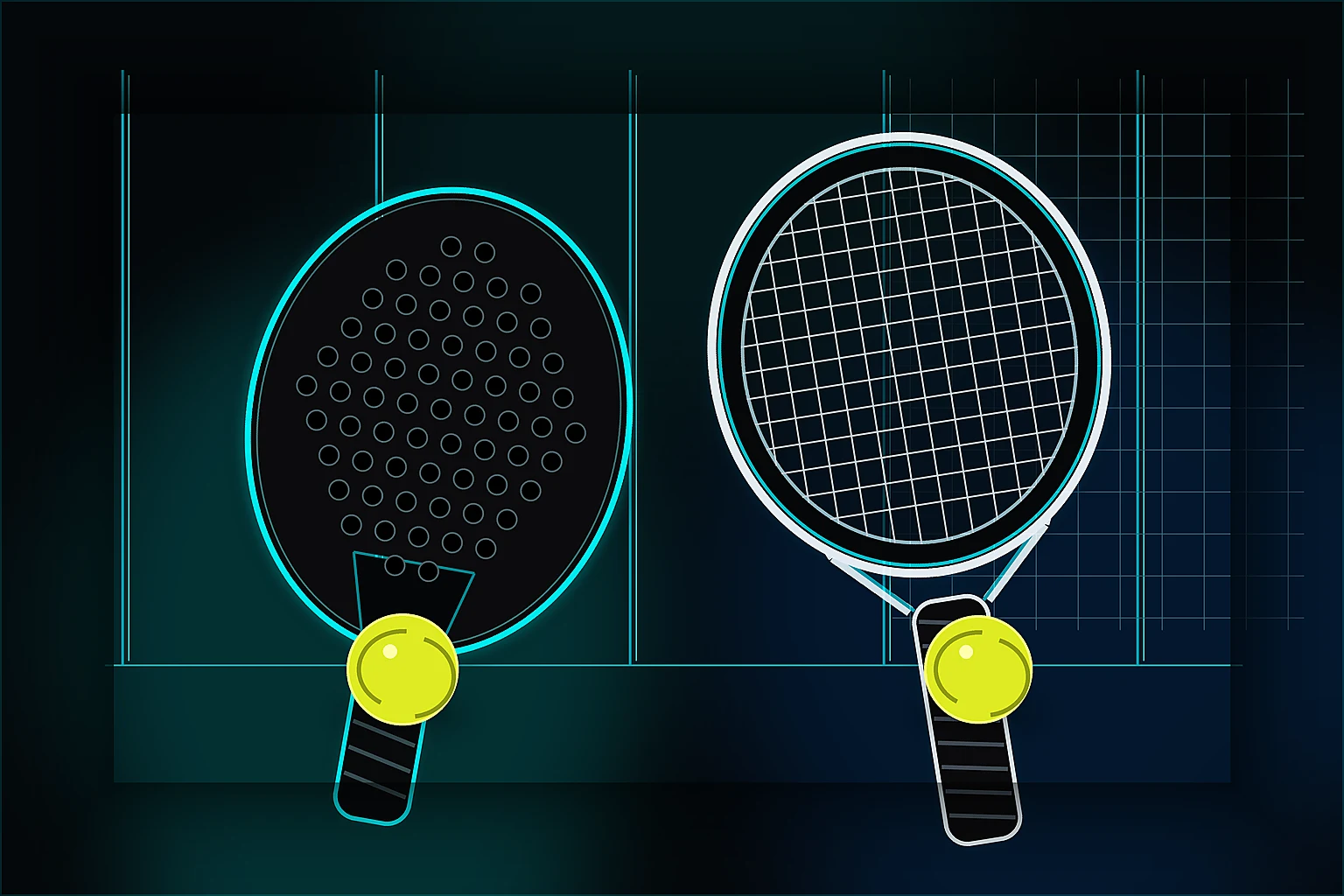
Padel and tennis look related at first: a net, rackets, a ball and a familiar scoring system. On court, however, padel feels very different. The main reason is the smaller enclosed court with glass and mesh, plus the solid racket, the underhand serve and a style of play built around control, angles and teamwork.
The biggest difference between padel and tennis is the court: padel is played on a smaller enclosed court where the glass walls and mesh can be part of the rally after the ball has bounced. Tennis is played on a larger open court where walls are not part of play.
Padel vs tennis at a glance
Padel is not simply a tennis variant. It is a separate racket sport with its own rules, court and equipment. People sometimes say padel tennis, but the official and common international name is padel.
Smaller enclosed court, glass walls, mesh, usually doubles, underhand serve after a bounce and a solid racket without strings.
Larger open court, singles and doubles, serve before the ball bounces and a strung racket.
Court and playing area
A standard padel court measures 20 by 10 metres and is enclosed by glass and mesh. A tennis court is 23.77 metres long, 8.23 metres wide for singles and 10.97 metres wide for doubles.
The smaller court changes everything. Padel rallies stay alive more often and positioning as a pair matters constantly. Tennis leaves more open space to cover, especially in singles.
Glass, mesh and wall play
The walls are the difference you feel immediately. In padel, once the ball has bounced legally, it may hit the glass or mesh and remain in play. In tennis, a ball that leaves the open court is normally out.
In padel, the ball must hit the court first. After that, glass and mesh can come into play.
This creates longer rallies and different decisions. You do not need to take every ball early. Sometimes the smart play is to let it rebound from the glass and return it with control.
Racket and ball
A tennis racket has strings. A padel racket has a solid perforated hitting surface and a wrist strap. It plays more compactly and with less trampoline effect than a tennis racket.
Padel racket
No strings, shorter handle, solid face and more control with compact movements.
Tennis racket
Strung hitting surface, longer swings, more reach and a different way of generating speed.
Padel balls are also not simply the same as tennis balls. They look very similar, but have their own specifications and usually feel slightly more controlled in play.
Serve and scoring
In padel, the serve is hit after the ball has bounced and the contact point must be at or below waist height. The ball is served diagonally into the opposite service box.
In tennis, the ball is released from the hand and struck before it hits the ground. The typical tennis serve is therefore more dynamic and more focused on pace.
The scoring is broadly similar: 15, 30, 40, game. Depending on competition format, padel may use Golden Point, No-Ad or other variants.
For the full rule guide, read Padel rules explained.
Playing style and tactics
Tennis rewards court coverage, strong groundstrokes, serve quality and open angles. Padel rewards patience, positioning, controlled angles, volleys, wall reading and coordination with your partner.
That does not make padel easy. At a good level, players use the glass to defend, reset or create pressure, and the transition to the net becomes a major tactical theme.
A doubles comparison study found more distance, more sprints and higher speeds in tennis, while padel produced more rallies and longer active playing time. In practice, tennis often feels more running-heavy, while padel can be intense through repeated rallies and quick reactions.
Which is easier for beginners?
Many beginners reach enjoyable rallies faster in padel. The serve is less dominant, the court is smaller and doubles means no one has to cover the full court alone.
That does not mean padel is simple. As the level rises, wall play, positioning, control and decision-making become highly demanding.
Does tennis experience help with padel?
Yes. Tennis experience helps with ball feel, volleys, timing and coordination. Many tennis players therefore get into padel quickly.
They still need to adjust. Big swings, hard baseline shots and taking every ball before the wall do not always work in padel. Wall play, compact strokes and doubles positioning matter more.
Padel or tennis, which fits you better?
you want rallies quickly, enjoy team play and like angles, tactics and social doubles.
you enjoy singles, larger court coverage, serve development and a longer technical progression.
The best answer is to try both. Many players keep playing both sports because they develop different strengths.
Where to try padel
You need a real padel court with glass and mesh. Use the padel court finder or start with padel near you.
Padel vs tennis FAQ
What is the biggest difference between padel and tennis?
The court. Padel is played on a smaller enclosed court where glass and mesh are part of the game after the ball has bounced.
Is padel easier than tennis?
Padel is often easier to start, but advanced padel is tactically and technically demanding.
Is padel a type of tennis?
No. Padel is a separate sport, although people sometimes use the term padel tennis.
Are padel balls the same as tennis balls?
No. They look similar, but padel balls have their own specifications.
Sources
Want to try padel?
Find nearby padel courts, check indoor and outdoor options and book your first match.
Find padel near me arrow_forward