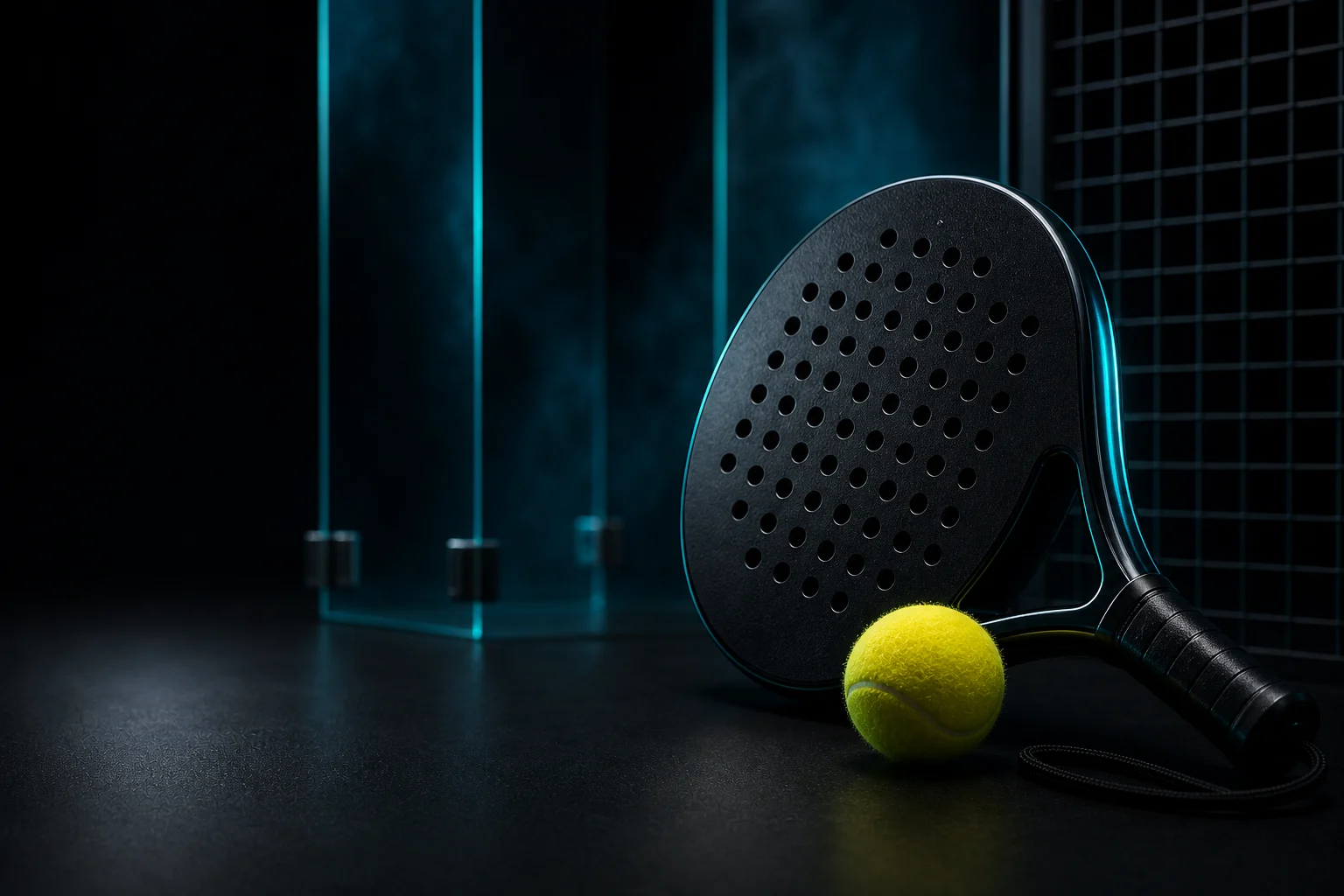
Padel is a racket sport usually played as doubles on a 20 by 10 metre court. A net separates the two teams, while glass walls and metal mesh surround the playing area and are part of the game.
Padel combines ideas from tennis and squash, but it is its own sport. You play the ball over a net with a compact solid racket. After the first bounce, the ball may touch glass or mesh and still remain in play.
What is padel?
Padel is a racket sport with its own rules. It is played over a net, but on a smaller enclosed court. The walls keep more balls in play and create situations you do not get in tennis.
The central idea is simple: first the ground, then the wall. A shot generally has to bounce in the opponent's court first. After that, it may touch glass or mesh. The other team can play it back as long as it has not bounced a second time.
This produces longer rallies. Padel is not only about power. Placement, patience, teamwork and court position often matter more than hitting hard.
Is padel tennis the same as padel?
In everyday language, padel is often called padel tennis. Most people mean the same sport. The official and internationally common name is padel.
The word tennis helps beginners understand the idea, because both sports are played over a net and use similar scoring. Still, padel is not a form of tennis. It has its own court, rackets, balls and rules.
Padel is also different from paddle tennis, pickleball and squash. Squash has no net. Pickleball is played on an open court with a plastic ball. Padel has its own mix of net play, doubles and walls.
How does padel work?
A padel match consists of rallies, games and sets. Most matches are played by two teams of two players.
Serve.
The ball bounces once before the serve and is hit at or below waist height diagonally into the opposite service box.
Return.
The receiver must let the serve bounce first. After that, volleys are allowed.
Rally.
After the first bounce, the ball may touch glass or mesh. It has to be played before the second bounce.
Point over.
A team wins the point when the opponents hit the net, allow two bounces or hit directly into the opponent's wall.
For a deeper rule explanation, read the guide Padel rules explained.
Padel vs tennis: the key differences
Smaller court, glass walls, mostly doubles, underarm serve and a compact racket without strings. Wall play and shared positioning shape the game.
Larger open court, singles and doubles, overarm serve and a strung racket. Walls are not part of normal play.
The biggest beginner difference: in padel, a ball can come back into play after touching the glass. A difficult looking ball may become easier after the back wall.
Court, glass, mesh and lines
A regular padel court is 20 metres long and 10 metres wide inside. The net divides it into two halves, and service lines mark the service boxes. Modern courts usually use glass at the back.
The glass walls create the wall game. If a low ball comes toward you, you do not always have to hit it before the wall. Often it is easier to let it bounce, read the rebound and play a controlled shot.
For your first match, remember this: the ball must bounce in the opponent's court before glass or mesh can help.
The most important padel rules in brief
- Padel is usually played as doubles.
- The serve is played after the ball bounces once.
- The serve is hit at or below waist height.
- The serve must go diagonally into the correct service box.
- The return of serve must bounce first.
- Volleys are allowed during the rally.
- The ball may bounce only once on each side.
- After the bounce, glass and mesh can be part of the rally.
- Players, clothes and rackets may not touch the net during play.
- Scoring is similar to tennis with 15, 30, 40 and game.
What equipment do you need for padel?
You do not need much for your first match. Many venues rent rackets and provide balls.
Padel racket
A padel racket is compact, has no strings and uses a solid perforated face. The wrist cord is part of safe play.
Padel balls
Padel balls look similar to tennis balls, but they have their own pressure and bounce requirements.
Shoes and clothing
Stable sports shoes with good lateral support matter. Running shoes are often not ideal for quick side steps.
If you want to buy your own racket later, the PadelCompass racket finder can help.
Is padel good for beginners?
Yes. Padel is one of the more accessible racket sports. Tennis or squash experience can help, but it is not required.
The serve is not hit overhead, the court is smaller than a tennis court and in doubles no one has to cover the whole area alone. At the same time, padel becomes very tactical as you improve.
For your first match, keep it simple: book a court, rent rackets, get a short explanation of the serve and wall logic, then focus on controlled rallies.
Common beginner problems and practical fixes are covered in common padel mistakes.
Where can you play padel?
Padel is played on purpose built courts at padel clubs, tennis clubs, sports halls, fitness centres, multisport facilities and outdoor venues.
The PadelCompass database currently lists 626 venues with 2,044 courts in Germany. You can filter by city, state, indoor courts, outdoor courts, rating and booking options.
Start with padel near you or browse all padel courts in Germany.
How much does padel cost?
Prices vary by city, venue, time of day and court type. Often the whole court is booked for a fixed time slot and the group splits the price.
Extra costs can include rental rackets, balls, coaching, beginner courses, open matches or memberships. For a first match, you usually do not need to buy your own equipment.
Frequently asked questions about padel
What is padel in simple terms?
Padel is a racket sport usually played as doubles on an enclosed court with glass and mesh walls. The ball is played over a net and may use the walls after bouncing.
Is padel tennis the same as padel?
Most people mean the same sport, but the official name is padel.
Do you play padel with two or four players?
The standard format is doubles with four players. Singles courts exist, but they are less common.
Can the ball touch the glass?
Yes. The ball must normally bounce in the court first. After that, it can touch the glass and still be played.
Sources
Ready to try padel?
Find padel venues in Germany with maps, ratings, courts, prices and direct booking where available.
Find padel near you arrow_forward